
AI Is Not Just ChatGPT. The New Cognitive Collaboration.

Did anyone say CHAT?

In our previous article we did discuss AI referring to my friend CHAT.

But...AI is not just your relationship therapist (Poor Chat), chatbots and shortcuts...
Did you know that...
AI that it is helping scientists predict the 3D shapes of molecules faster than ANY lab on Earth could?
Other than it is diagnosing rare diseases, decoding ancient languages, composing symphonies, and generating new materials atom by atom?
No? Do not worry. Most people do not.
When you hear "AI" you probably DON'T ACTUALLY know how any of it works...
The same way you don't really know HOW your laptop does half the things it does, or WHY your phone just knows what you were about to type.


AI feels magical because it is invisible. It is everywhere BUT nowhere.
It is SHAPING your choices BEFORE you even realize you are making them.
But here is the thing: AI is not one thing. It is a web of systems that learn from data to predict + simulate + even imagine ANDDDD the breakthroughs happening right now are quietly astonishing.
🇯🇵 In Japan, AI-guided microscopes are discovering new antibiotics by spotting microbial patterns no human could see.
🇬🇧 In the UK, DeepMind’s AlphaFold cracked the protein-folding mystery that stumped scientists for half a century.
🇺🇸 At MIT, AI weather models now predict global climate shifts faster and more accurately than satellites.

🇺🇸 NASA is using machine learning to map new exoplanets + reconstruct lost spacecraft data.

🇨🇭 And in Switzerland, researchers built an AI that reads brain activity and recreates rough images of what people are seeing, translating thoughts into pictures.


OK you get it. It's really amazing tho.
We are no longer in the age of automation. We have entered the era of cognitive collaboration.
The philosopher Hannah Arendt once wrote that every tool we invent also reinvents us. AI may be our most revealing mirror yet.
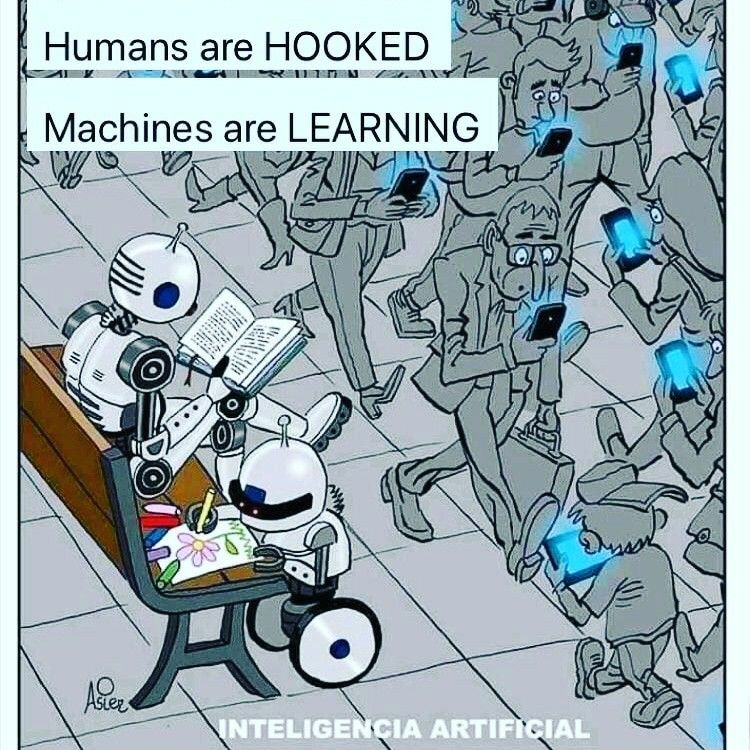
It exposes the limits of our cognition, the fragility of our job systems, and our yearning for EFFICIENCY...even when it costs us PRESENCE.
So the question isn’t only what AI can do, but what it leaves us to do.


As machines learn our role shifts toward meaning-making...understanding why something matters, not just HOW it works. Perhaps that is the challenge...and the gift...of this era: to rediscover the value of human thought in a world where thinking can be automated. And use AI to extend our thinking not replace it.
AI is no longer confined to our screens, it’s slipping into the architecture of science, the economy, and even the way we understand creativity.

This year, a team of researchers announced that they had trained an AI model, ESM3, to simulate half a billion years of evolution. The system generated a completely NEW fluorescent protein... esmGFP...one that doesn’t exist in nature...HELLO??...and yet functions as if it could. In other words, an algorithm compressed geological time into computation.
At the same time, laboratories are teaching AI not just to process data, but to think scientifically. These systems scan millions of research papers, simulations, and molecular structures to generate their own hypotheses... In some cases, even design and run digital experiments to test their ideas BEFOREEE a human scientist touches a pipette.

Imagine all that can be done for medicinal research!! (click here to read an example : AI generated a novel hypothesis about cancer cell behaviour).
Beyond discovery, tho...
Late October brought a symbolic headline: Amazon announced the layoff of 14k corporate employees, citing restructuring and a shift toward “greater agility”.
CEO Andy Jassy insisted the cuts were about culture, not cost...an attempt to make Amazon operate “like the world’s largest startup.” Yet beneath that language of agility lies a deeper structural shift: a workforce being reconfigured by the quiet, pervasive spread of AI.
For decades, technological progress has been framed as an EQUALIZER, every advancement creating new opportunities as it displaces old ones.
But AI complicates that story. Unlike past waves of automation that replaced physical labor, this one is encroaching on cognitive labor: the domains of pattern recognition, communication, decision-making, and design.
Recent studies sketch the scale of that transformation.
The IMF (2024) estimates that up to 60% of jobs in advanced economies are “exposed” to AI (meaning at least part of their core tasks can be automated or augmented)
The OECD suggests that roughly 45% of current occupations will undergo “substantial task redesign,” not elimination but redefinition, as algorithms begin to collaborate with human workers.

Meanwhile, PwC’s 2025 Global AI Outlook forecasts a $15.7 trillion boost to global GDP by 2030, with the largest productivity jumps in sectors integrating machine learning into decision-making + logistics + creative ideation. I mean I PERSONALLY worked in places with no AI, and it was HELL. AI is needed. So much time is wasted on manual tasks ( with of course a large margin of human error).

But what does that actually mean for us?


No, I'm joking, don't worry....
Across OECD economies (like the US, UK, Germany, Japan) , employers are quietly rewriting what it means to be skilled. As AI takes over the measurable, humans are being hired for the immeasurable...creativity + judgment + resilience. The job market is evolving from data-driven to meaning-driven.
In essence, the next decade won’t reward people who can outcompute machines, but those who can contextualize what machines compute.
This is where behavioral science becomes essential. The challenge ahead isn’t only about algorithms... it’s about ADAPTING: how humans change their behavior, perception, and motivation in response to new cognitive ecosystems.
Behavioral science offers the frameworks to understand and guide that adaptation:
How TRUST forms between humans & machines + how BIAS infiltrates automated systems + how purpose and identity shift when decision-making is shared with code.
It helps us design systems that work with human nature, not against it, nudging creativity + CURIOSITY instead of compliance, reflection instead of reaction. Be curious, keep learning and train your mind to be agile and creative.
AI may optimize performance, but behavioral insight humanizes it. It ensures that efficiency doesn’t erase empathy, that we still remember what progress is for.


Comments