
Dinosaurs. A few million years, you say?

Updated: Oct 9, 2025
165 million years of balance vs. 2,000 years of self-importance.

Jurassic Park? Amazing movie. I wish it was real bth... but... is it accurate? Well....
Dinosaurs ruled Earth for about 165 million years (give or take a few million depending on where you draw the evolutionary line). That’s not a typo. One-hundred-and-sixty-five million.
To put that in perspective: Homo sapiens, us, have been around for ONLY about max 300,000 years. And what we call “Western civilization,” mostly scaffolded on Christianity, clocks in at a mere two millennia. In the history of life. History of our planet (you should know the Earth's age since elementary school...but in case you don't...its 4.54 ± 0.05 billion years btw) it's what? NOT MUCH UH?
Yet here we are, treating the Earth like our doormat. Treating our experiment of dominance like it’s the center of the universe. The start of time. The ultimate accomplishment of nature.

Contrary to their Hollywood image, dinosaurs weren’t reckless destroyers.
They came in all shapes: lumbering long-necks that could vacuum up half a forest in an
afternoon, raptors with teeth made for efficiency, and creatures with horns, sails, and...

...armor plates that would make a Marvel designer blush.
They thrived in ecosystems across the planet...deserts, swamps, coastlines...adapting again and again for over a hundred million years. They didn’t pave over their world. They fit into it.
Dinosaurs didn’t just appear and vanish in one long blur; they stretched across three geologic chapters.
The Triassic Period (about 230 million years ago) was their scrappy start, with small, two-legged dinos testing the evolutionary waters.

Then came the Jurassic, the blockbuster age of giant sauropods like Brachiosaurus and the rise of predators like Allosaurus.
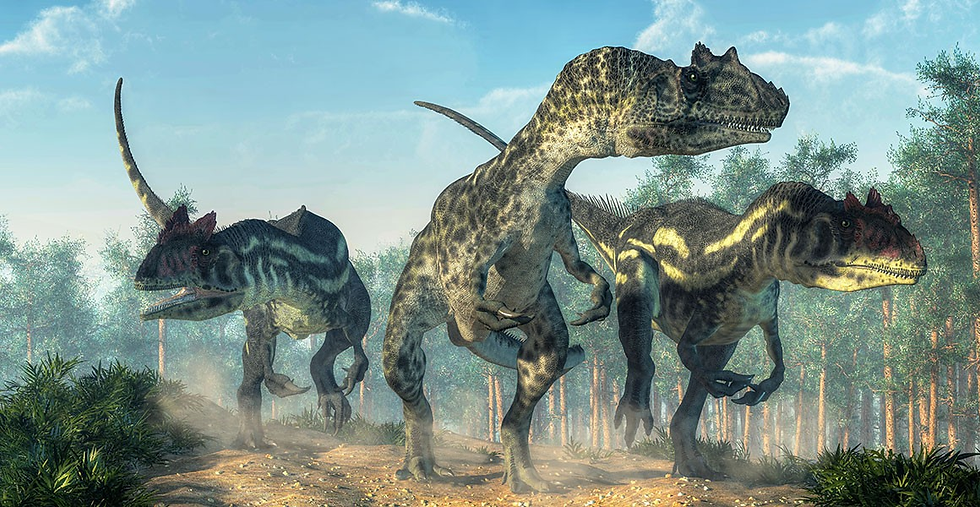
Allosaurus lived at the end of the Jurassic Period in what is now North America and Western Europe. It was almost 10m long and hunted other large dinosaurs, such as Stegosaurus. © Daniel Eskridge/
Finally, the Cretaceous brought the celebrities: Triceratops, Velociraptor, and the iconic T. rex. To give you a sense of scale: Stegosaurus from the Jurassic was already a fossil for 80 million years before T. rex ever showed up.
Dinosaurs were an empire...until the sky quite literally fell.
University of Edinburgh paleontologist Stephen Brusatte says “Today, about 14,000 dinosaur species live on as birds, do the math and we’re probably talking about millions of dinosaur species that once lived, maybe tens of millions.”
Which means what we “know” (around 2k species, 700 named) is barely a postcard from a civilization that lasted longer than anything we’ll ever build.
Fun fact, you probs saw on social media: dinosaurs aren’t completely gone. Birds are their direct descendants, especially those of the theropod group, which includes Velociraptor. Chickens, in particular, are genetically closer to T. rex than to crocodiles. So yes, when you eat nuggets, you’re literally feasting on the last living branch of the dinosaur family tree.

As for their grand finale... we all think we know. Asteroid, Crash. Bye bye.
About 66 million years ago, a 10-kilometer-wide asteroid slammed into the Yucatán Peninsula releasing more energy than billions of atomic bombs, igniting wildfires, throwing molten rock into the sky, and sending dust clouds that blotted out the sun. Photosynthesis collapsed, food chains unraveled, and within a geological heartbeat, 75% of life on Earth was gone. The non-avian dinosaurs, the ones without wings, didn’t stand a chance.
Only the survivors of chance and adaptability made it through....

In other words: the chickens won.

What came after looked less like an apocalypse and more like a reboot. Mammals, once small, nocturnal, and overshadowed, suddenly had space to thrive. Birds spread into new niches. Plants reshuffled. The age of dinosaurs gave way to the age of mammals and eventually, us. Life didn’t end; it just reinvented itself, as it always does.
The irony?
Dinosaurs didn’t design their own extinction.
We might.

Our version of dominance looks like skyscrapers, cement, and a carbon footprint big enough to make a T. rex wheeze. They were victims of cosmic chance; we’re victims of ourselves.
Dinosaurs lasted 165 million years without Wi-Fi, democracy, or quarterly earnings reports. What are we accomplishing as a species here?

If they could look at us now, they’d probably just shake their tiny arms and laugh.

This was't even the worst exctintion ever...
The Great Dying happened too. Lol.
EXTRA CONTENT
A little more if you are a curious one
Do you want to know more about how THEY ACTUALLY died?
The timeline of dinosaur extinction after the asteroid is one of those misunderstood things (it wasn’t instant, but it was brutally fast on a geological clock).
The Impact
Within hours, the immediate region was obliterated by firestorms, tsunamis hundreds of meters high, and shockwaves that circled the globe. Any animal within a few hundred kilometers of ground zero likely died instantly.
Days to Weeks
Ejecta (molten rock and dust) rained back down through the atmosphere, heating the air and sparking global wildfires. Temperatures spiked to lethal levels in many regions. Some scientists estimate that as much as 75% of life on Earth was doomed by these cascading effects.
Months to Years
Dust and aerosols in the atmosphere blocked sunlight, causing a “nuclear winter.” Photosynthesis collapsed, plants died, herbivores starved, carnivores followed. Oceans acidified from chemical fallout.

Hey, where you going ? Got 10 more mins? Wrap up with this video.
SUMMARY

Sources:
Theropod dinosaur facial reconstruction and the importance of soft tissues in paleobiology” by Thomas M. Cullen, Derek W. Larson, Mark P. Witton, Diane Scott, Tea Maho, Kirstin S. Brink, David C. Evans and Robert Reisz, 30 March 2023, Science.DOI: 10.1126/science.abo7877


Comments