
Echo Chamber Effect: Modern Bubbles, Distorting Realities.

Updated: Oct 10, 2024
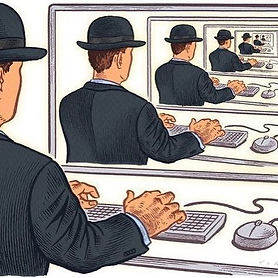
We all looooove a good conversation. One where everyone nods in agreement, backs up your points, and reassures you that you are on the right side of things. It feels good, right?
In today's hyperconnected world, it is easy to feel informed, plugged into the pulse of current events, conversations, and trends. We scroll, we debate.
But here’s the question: Are you just hearing the echo of your own thoughts?
Welcome to the Echo Chamber: An insidious digital bubble where the ideas you are exposed to are merely reflections of what you already believe. It’s a comforting space, yes, but also one that can distort your reality and harden your beliefs. While we think we are broadening our horizons, we are often just deepening the trenches of our own biases.
What is an Echo Chamber, Really?
An echo chamber is more than just a space where like-minded people gather—it’s a cognitive trap, a feedback loop where beliefs are amplified and dissent is filtered out.
In this closed environment, opposing views rarely penetrate, and when they do, they’re often dismissed or vilified. It’s a place where certainty grows and nuance dies.
The Digital Age: How Algorithms Fuel the Echo

In the pre-digital era, echo chambers existed in our social circles, communities, or workplaces.
Now, the internet—particularly social media—has turned them into a full-blown phenomenon.
Algorithms are designed to maximize engagement, and how do they do that? By feeding us more of what we already like. The result? A curated reality where every scroll, click, and interaction reinforces our worldview.
This algorithmic personalization, whether it’s political news, cultural debates, or entertainment platforms, it quietly construct a bubble around us. With each piece of content, our beliefs feel more justified, more concrete, and less challengeable.
The Cognitive Cost of Echo Chambers
Confirmation Bias on Steroids: We already know that people tend to seek information that supports their existing views, but in an echo chamber, this bias becomes a default mode. Every piece of content we consume in these environments strengthens what we already believe, making it harder to critically assess new or opposing ideas.
Intellectual Stagnation: Exposure to diverse viewpoints is essential for intellectual growth. When our ideas go unchallenged, we stop refining them. Echo chambers create the illusion of consensus, giving us false confidence that we hold the "right" views. This leads to intellectual laziness, as there’s no longer a need to question, evolve, or consider alternate perspectives.
Polarization and the Extremes: The longer we dwell in these echo chambers, the more polarized we become. When every voice you hear echoes your own, opposing views seem not just different, but fundamentally wrong—or even dangerous. Over time, echo chambers don’t just reinforce ideas; they push them to extremes. What begins as a moderate stance hardens into something far more rigid.
The Misinformation Epidemic: Echo chambers are breeding grounds for misinformation. When false information enters these closed loops, it’s rarely questioned, especially if it aligns with the dominant narrative. Repetition breeds familiarity, and familiarity often masquerades as truth. The more something is repeated in an echo chamber, the more credible it seems, regardless of its accuracy.
Why Do We Stay in Echo Chambers?

There is an instinctual pull toward the safety of shared beliefs. Confronting opposing ideas is cognitively taxing and emotionally uncomfortable. When we engage with information that contradicts our views, we experience cognitive dissonance—the mental discomfort of holding conflicting ideas. The echo chamber offers a refuge from that discomfort. It’s a space where our beliefs are continually validated, making us feel right, smart, and part of the “correct” group.
But more than comfort, there’s a psychological reward system at play.

When others agree with us, our brain releases...
—GUESS WHAT? Dopamine!— the same chemical tied to pleasure and reward.
This makes the echo chamber not just a space of intellectual reinforcement but also one of emotional satisfaction. We feel good when we’re validated, and echo chambers become addictive spaces where we seek that dopamine rush of agreement.
Breaking Free: How to Escape the Echo

Intellectual Curiosity Over Comfort:
This means actively seeking out opposing viewpoints, not with the intent to argue, but with a genuine desire to understand.
Ask yourself: When was the last time I changed my mind about something significant?
Diversify Your Information Sources:
Deliberately seek out sources that challenge your beliefs. Whether it's reading publications from across the political spectrum, or following thinkers you disagree with, intellectual diversity is key to keeping your worldview expansive.
Practice Intellectual Humility:
Acknowledge that your current views, no matter how deeply held, are not infallible. Intellectual humility is the recognition that no one has a monopoly on truth.
Engage in Real Dialogue:
Instead of shutting down or avoiding conversations with those who disagree with you, engage with them. Listen, not to refute, but to understand. Real dialogue fosters empathy and prevents the kind of intellectual isolation that echo chambers thrive on.
The Broader Implication: Society’s Fragmentation
On a societal level, the proliferation of echo chambers is contributing to increased polarization. We see it in politics, culture, and even science. When people stop engaging with differing perspectives, it is not just individuals who suffer—it’s society as a whole. Discourse fractures, compromise becomes impossible, and the idea of a shared reality starts to slip away. Echo chambers, in many ways, are the antithesis of the democratic ideal.

So, What's Next?
Breaking free from an echo chamber isn’t easy—it requires effort, humility, and a willingness to be uncomfortable. But it’s necessary if we’re going to escape the intellectual stagnation, polarization, and misinformation that echo chambers breed. The world is complex, multifaceted, and rarely black-and-white. The more we open ourselves to that complexity, the better equipped we are to navigate it intelligently.
The Challenge: Are you brave enough to pop the bubble?


Can you show humility in what you know, and with empathy, truly listen to others? Are you willing to accept your limited reach?


Comments